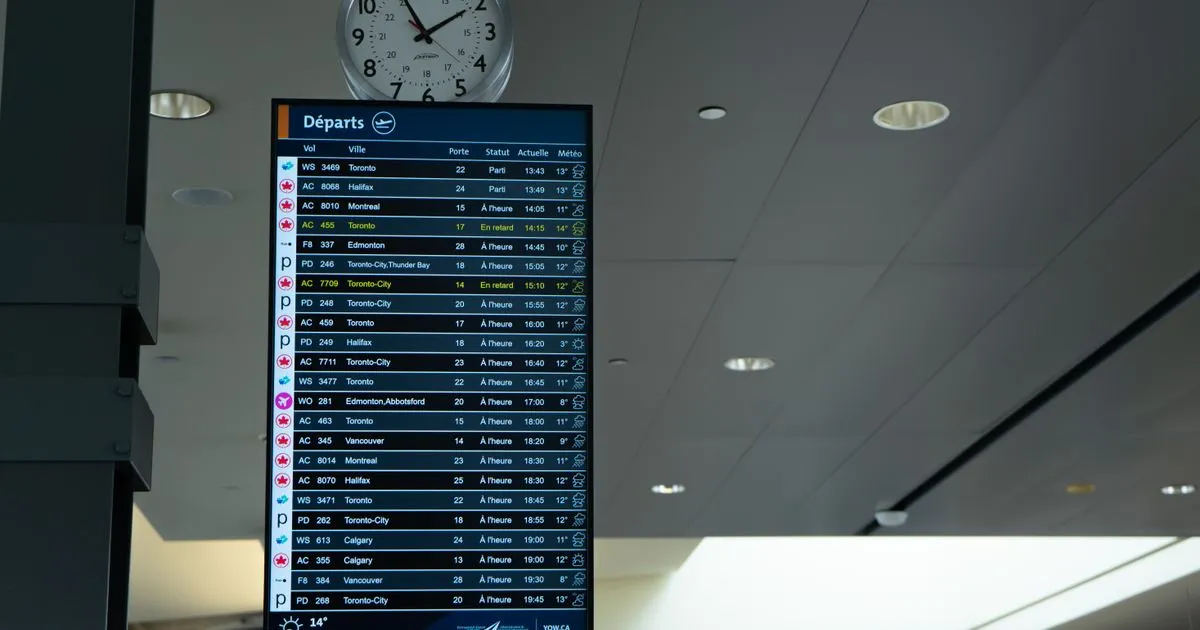
Flight Delay Compensation: How to Claim the €600 You're Owed
A flight delayed 3+ hours can owe you up to €600 under EU261, yet over 60% of travelers never claim. How to check eligibility and claim with Compensair.
You are at the gate, watching the departure time slide back another hour. The board flips to “Delayed,” the staff have no answers, and your evening plans are quietly falling apart. Annoying, yes. But here is the part most travelers miss: that delay might owe you up to 600 euros in cash, and the airline is in no rush to tell you.
This guide covers when a delay turns into a payout, the excuses airlines use to dodge it, and how to claim what you are owed in a few minutes with Compensair, a no-win, no-fee service that does the fighting for you.
Key Takeaways
- A delay of 3 or more hours at your final destination can mean 250 to 600 euros per passenger under EU Regulation 261/2004 (EUR-Lex, 2004)
- Over 287 million passengers in Europe were hit by delays or cancellations in 2024, about a third of all travelers (AirHelp, 2024)
- More than 60% of disrupted passengers never claim, and only 21% can correctly say when they are entitled to money (AirHelp, 2025)
- Airlines wrongly reject about 52% of valid UK claims on the first try, often citing “extraordinary circumstances” that do not apply (Aerospace Global News, 2025)
- Compensair handles the claim on a no-win, no-fee basis, taking a 30% success fee only if it recovers your money (Compensair, 2026)

How common are flight delays, really?
Delays are not rare bad luck. In 2024, more than 287 million passengers across Europe had a flight delayed or cancelled, roughly one in three travelers (AirHelp, 2024). The average European flight ran 17.5 minutes late, and only 72.4% arrived within 15 minutes of schedule (EUROCONTROL, 2024).
The United States tells the same story. The Bureau of Transportation Statistics recorded 1,531,080 delayed flights in 2024, about 20.3% of the schedule, plus 102,908 cancellations (US DOT BTS, 2024). AirHelp put the human total at 236 million US passengers disrupted in a single year (AirHelp, 2024).
And the trend is the wrong way. European air traffic control delays have doubled over the past decade, rising 114% between 2015 and 2024 while flight numbers grew less than 7% (IATA, 2025). Crowded skies, thin staffing, and summer strikes mean more of us will spend more time stuck at the gate, not less.
What does a delay actually cost you?
Plenty, and not just in patience. In a 2024 survey, 73% of US travelers said they had lost money on a flight disruption beyond the ticket price, covering hotels, meals, missed earnings, and transport the airline never refunds (Moneywise, reporting AirHelp data, 2024). People call it the “delay tax.”
There is an emotional cost too. J.D. Power’s 2025 study found that passengers who hit a problem scored 125 points lower on airline trust, on a 1,000-point scale, than those who flew clean (J.D. Power, via The Manual, 2025). Flight delays were the single most common problem reported. Loyalty cracks fast: 81% of travelers with a “perfect” trip said they would definitely rebook the airline, against just 4% of those with a “poor” one.
Here is what people forget in the moment. Regardless of why your flight is late, the airline owes you care: free meals and drinks for a long wait, plus a hotel and transfers if you are stuck overnight (European Commission, 2025). Those rights apply even when no cash compensation does. Ask for the vouchers. Keep every receipt.

When are you owed flight delay compensation?
You are owed a fixed cash payout when you reach your final destination 3 or more hours late, on a flight covered by EU or UK rules, and the cause was within the airline’s control. The 3-hour trigger comes from the 2009 Sturgeon ruling, and it is measured by arrival, not departure (Court of Justice of the EU, 2009). So a flight that pushes back late but makes up the time in the air may not qualify, while one that lands 3 hours behind does.
The amount scales with distance, set in Article 7 of EU Regulation 261/2004 (EUR-Lex, 2004). The UK kept its own near-identical version, UK261, paid in pounds and enforced by the Civil Aviation Authority (UK CAA, 2025).
| Flight distance | EU261 payout | UK261 payout |
|---|---|---|
| Up to 1,500 km | €250 | £220 |
| 1,500 to 3,500 km (or intra-EU over 1,500 km) | €400 | £350 |
| Over 3,500 km | €600 | £520 (£260 if 3 to 4 hours late) |
The rules cover any flight departing an EU airport on any airline, and flights arriving in the EU from outside when operated by an EU carrier (European Commission, 2025). Iceland, Norway, and Switzerland are included. UK261 covers departures from any UK airport and arrivals into the UK on UK or EU airlines. One caveat on the long-haul tier: a 3-to-4-hour delay over 3,500 km can be reduced by half, to €300, which is why the UK splits its top band into £260 and £520.
The “extraordinary circumstances” excuse airlines hide behind
When an airline says no, it almost always blames “extraordinary circumstances,” the one exemption written into Article 5(3) of the regulation. The trouble is that this defense is narrower than airlines pretend, and they lose on it often.
Genuine extraordinary circumstances are things outside the airline’s control: severe weather, air traffic control restrictions, political instability, and security risks (European Commission, 2025). What does not count is just as important. The EU’s top court ruled that ordinary technical or mechanical faults are part of running an airline and do not excuse payment (Wallentin-Hermann, C-549/07, 2008). It also ruled that strikes by the airline’s own staff, including sudden wildcat walkouts, are not extraordinary either (Krusemann, C-195/17, 2018).
That gap between what airlines claim and what the law says is why so many refusals collapse under pressure. AirHelp’s review of its 2024 caseload found that airlines wrongly rejected about 52% of valid UK claims at the first response, frequently leaning on vague excuses or simply not replying (Aerospace Global News, 2025). A first “no” is not the end. It is often just the airline hoping you give up.
Why do most people never claim?
Because the system is built to be confusing, and airlines rarely volunteer the truth. AirHelp’s 2025 survey of 3,100 travelers found that while 81% knew passenger rights exist, only 21% could correctly identify when they were actually entitled to money (AirHelp, 2025). Worse, airlines told passengers about their rights in only 40% of disruptions.
So the money piles up unclaimed. AirHelp has estimated that more than 6 billion US dollars in compensation goes uncollected each year, roughly 13 million passengers walking away from cash they were owed (AirHelp, 2018). Only about 40% of disrupted travelers even try to claim. The other 60% leave it on the table, usually because they never knew it was there.
That is the real reason a service exists. The entitlement is the easy part. Proving it to an airline that would rather stall is the hard part, and it is exactly the part you can hand off.
Our take: the awareness gap is the airline’s best friend. Every traveler who assumes “delays just happen” is one less claim to pay. Checking takes two minutes and costs nothing, so the only bad move is not checking.
Want to know if your flight qualifies? Enter the route and date below and Compensair will estimate what you are owed.
This is an affiliate tool. If your claim succeeds through Compensair we may earn a commission, at no extra cost to you.
How to claim with Compensair
Compensair is a no-win, no-fee claims service that takes your delayed, cancelled, or overbooked flight and chases the airline for the payout, so you do not have to. Operating since 2016, it carries an “Excellent” rating on Trustpilot (Compensair, 2026). The process is short:
- Check eligibility. Enter your flight details in the widget above or on Compensair’s site. It is free and takes a couple of minutes.
- Submit your claim. Upload your booking reference and a passport or ID. Compensair files the paperwork and handles all contact with the airline.
- Let them fight it. If the airline rejects a valid claim, Compensair pushes back and, where needed, escalates toward legal action.
- Get paid. Once the airline pays, your share is transferred to you.
What it covers and what it costs:
- Disruptions: delays over 3 hours, cancellations, denied boarding from overbooking, and missed connections (Compensair, 2026).
- Payout: up to 600 euros per passenger, set by the EU261 distance bands above.
- Fee: a 30% success fee taken from the recovered amount, plus a 10% legal fee only if the case goes to court (Compensair Payment Policy, 2023). If the claim fails, you pay nothing.
- Time to settle: about 8 weeks for a straightforward case, or 16 to 20 weeks if it needs court action (Compensair, 2026).

DIY or use a claims service?
You can always claim direct with the airline and keep 100% of the payout, and for a clear-cut delay that the airline admits to, that is the cheapest route. The trade-off is time and friction. If the airline stalls, denies, or goes silent, you are the one writing follow-ups, citing case law, and deciding whether to take it to a regulator or small-claims court.
| Claim it yourself | Use Compensair | |
|---|---|---|
| Cost | Free, you keep 100% | 30% success fee, only if you win |
| Effort | You handle every email and appeal | They do the paperwork and chasing |
| If the airline says no | You escalate alone | They push back and can go legal |
| Risk | Your time, possibly wasted | Pay nothing if the claim fails |
| Best for | Simple, admitted delays | Rejected, ignored, or disputed claims |
The honest rule of thumb: try the airline yourself first if the case is obvious. If you get a “no,” a wall of silence, or an “extraordinary circumstances” letter you suspect is bogus, that is when a service earns its cut. You swap a slice of the payout for someone who does this all day and is not intimidated by an airline’s legal team.
How far back can you claim?
Further than most people think. The deadline depends on the country whose law governs your flight, and the windows are generous in much of Europe (Flight-Delayed.com, 2025).
| Country | Time limit to claim |
|---|---|
| United Kingdom (England and Wales) | 6 years |
| Scotland | 5 years |
| France | 5 years |
| Spain | 5 years |
| Germany | 3 years |
| Netherlands | 2 years |
Compensair generally accepts flights from the last 2 to 6 years, depending on the airline and route (Compensair, 2026). So that miserable delay from two summers ago may still be worth money. If you have flown a delayed or cancelled route through Europe or the UK recently, it is worth a quick check before the clock runs out.
Are the rules about to change?
Not yet. As of July 2026, the long-standing rules still apply in full: the 3-hour trigger and the 250, 400, and 600 euro tiers are unchanged. A proposed reform to raise the delay threshold has been stuck in negotiation between the European Parliament and the Council, with the Parliament defending the 3-hour line as a red line (European Parliament, 2026). Until any change is actually adopted and in force, claim under the current rules, which are the more generous ones.
Frequently asked questions
How much compensation can I get for a delayed flight?
Under EU261 you can claim 250 euros for flights up to 1,500 km, 400 euros for 1,500 to 3,500 km, and 600 euros for flights over 3,500 km, when you land 3 or more hours late. The UK pays 220, 350, and 520 pounds under UK261. The exact figure depends on distance, not ticket price.
Does a short delay or a cheap ticket still qualify?
Compensation starts at a 3-hour arrival delay, and the payout is fixed by distance, so it can easily exceed what you paid for a budget fare. Below 3 hours there is no cash payout, but you still get care rights like meals and, for overnight waits, accommodation, whatever the cause.
Can the airline really refuse over weather or strikes?
Genuine extraordinary circumstances such as severe weather, air traffic control decisions, or security alerts can exempt an airline. But routine technical faults and strikes by the airline’s own staff do not count, per EU court rulings. Around 52% of valid UK claims are wrongly rejected at first, so a “no” is worth challenging.
Is it worth using Compensair instead of claiming myself?
If your claim is simple and the airline agrees, claiming direct keeps the full payout. If you have been rejected, ignored, or handed a vague excuse, Compensair’s no-win, no-fee model means you risk nothing: it only takes its 30% fee when it actually recovers your money.
What if my flight was years ago?
You may still be in time. Limits run from 2 years in the Netherlands up to 6 in the UK, and Compensair accepts flights from roughly the last 2 to 6 years depending on the route. It costs nothing to check an old delay, so there is no downside to trying.
Bottom line
Flight delays are common, getting more so, and quietly expensive. Yet the rules are firmly on the passenger’s side: a 3-hour delay on a covered flight can owe you up to 600 euros, the “extraordinary circumstances” excuse is weaker than airlines let on, and you have years to act in most of Europe. The only thing standing between most travelers and that money is knowing it exists and being willing to push.
So push. Check your last disrupted flight, and if it qualifies, let a no-win, no-fee service do the chasing. Then get back to the part of travel you actually signed up for.
Heading somewhere next? Compare fares across 700+ airlines and booking sites before you fly.
For more on protecting your trip, read our guides on whether travel insurance is worth it, making the most of a long layover, and the booking mistakes that cost travelers hundreds.
Sources
- European Union, Regulation (EC) No 261/2004, Article 7, retrieved 2026-06-09, https://eur-lex.europa.eu/legal-content/EN/TXT/HTML/?uri=CELEX:32004R0261
- Court of Justice of the EU, Sturgeon v Condor (C-402/07), retrieved 2026-06-09, https://eur-lex.europa.eu/legal-content/EN/TXT/?uri=CELEX:62007CJ0402
- European Commission, Air passenger rights (Your Europe), retrieved 2026-06-09, https://europa.eu/youreurope/citizens/travel/passenger-rights/air/index_en.htm
- UK Civil Aviation Authority, Flight delays - your rights, retrieved 2026-06-09, https://www.caa.co.uk/air-passengers/travel-problems-and-rights/flight-delays-and-cancellations/delays/
- EUROCONTROL, All-Causes Delays to Air Transport in Europe - Annual 2024, retrieved 2026-06-09, https://www.eurocontrol.int/publication/all-causes-delays-air-transport-europe-annual-2024
- US DOT Bureau of Transportation Statistics, Air Travel Consumer Report (Full Year 2024), retrieved 2026-06-09, https://www.transportation.gov/briefing-room/air-travel-consumer-report-december-2024-full-year-2024-numbers
- AirHelp, Air Passenger Rights Survey 2025, retrieved 2026-06-09, https://www.airhelp.com/en/blog/air-passengers-rights-survey-2025-what-we-found-out/
- IATA, European Air Traffic Control Delays Double Over Last Decade, retrieved 2026-06-09, https://www.iata.org/en/pressroom/2025-releases/2025-12-09-03/
- Compensair, FAQ and Payment Policy, retrieved 2026-06-09, https://www.compensair.com/en/faq.html
Some links on this page are affiliate links: if you buy or book through them we earn a commission at no extra cost to you. Read the full disclosure.
Read next

Save Money Booking Southeast Asia 2026: Honest 5-Site Comparison
Westerners overpay $300-700 on Southeast Asia trips. Honest comparison: Google Flights vs Expedia vs Booking vs Trip.com vs Paglipat, with real prices.
May 14, 2026
Thailand Fat Camps: The Honest Guide to Weight Loss Retreats
Thailand became the world's weight loss camp capital for a reason. Muay Thai fitness programs in Phuket, detox retreats in Koh Samui, wellness sanctuaries in C…
Apr 24, 2026
We Sponsored an Amateur Football Tournament in the Philippines. Here'…
Paglipat sponsored a 7-a-side amateur football tournament in the Philippines. One YouTuber, a multinational squad, and the dream of proving that money can buy…
Mar 15, 2026