
Chiang Mai Digital Nomad Cost of Living: Is It Worth It?
Nomad List pegs a Chiang Mai digital nomad's monthly cost near $1,187. Here is the real breakdown of rent, coworking, food, air quality and visas.
Chiang Mai has been the default answer to “where should a digital nomad go?” for over a decade. The numbers still back it up. Nomad List ranks it #5 in the world as of July 2026, with a 4.06 out of 5 community score and roughly 12,000 remote workers on the ground (Nomads.com, 2026). It also puts a nomad’s typical all-in cost at about $1,187 a month.
But “cheap and easy” is doing a lot of work in that sentence. Rents are climbing, the cheapest-in-Asia crown has slipped, and for two months every year the air is genuinely dangerous. This is the honest 2026 cost breakdown: what you will actually pay, what has changed, and who should book a flight somewhere else. For the full picture on neighborhoods, temples, and food, pair this with our evergreen Chiang Mai digital nomad guide.
Key Takeaways
- A comfortable nomad budget runs about $1,800 to $2,500 a month; a lean one closer to $800 to $1,200 (Nomad List, Midlife Nomads, 2026).
- A one-bedroom in trendy Nimman costs roughly $384 a month versus about $256 in local Santitham (CNX Local, 2026).
- Thailand’s median fixed broadband hit 275.26 Mbps in December 2025, 10th fastest on earth (Ookla Speedtest Global Index).
- Burning season is the dealbreaker: Chiang Mai hit an AQI of 263 on 29 March 2026 (IQAir).
- The DTV visa gives remote workers 5 years and 180 days per entry; 60-day visa-free entry is still live but under review.
How much does it cost to live in Chiang Mai as a digital nomad?
In 2026, a typical digital nomad spends about $1,187 a month in Chiang Mai, according to Nomad List’s live cost index (Nomads.com, 2026). That figure covers a private condo, coworking, eating out, and a social life. Strip it back to a local lifestyle and the same source drops to around $800; add a family and it climbs to $1,622.
The single number hides how much your own habits matter. Nomad List breaks the city into four lifestyle tiers, and the gap between them is wider than most “Chiang Mai is $500 a month” posts admit.
Cross-check against real budgets on the ground and it gets more concrete. A budget freelancer can live on $900 to $2,000, while a salaried remote worker who eats out daily and keeps a nice condo lands nearer $2,900 to $6,000 (CNX Local, 2026). Most people reading this will sit between $1,200 and $2,500.
Our take: The “$500 a month” Chiang Mai you read about on older blogs still technically exists, but it means a fan room, street food three times a day, and no coworking. Budget $1,500 as a realistic floor for a Western remote worker who wants aircon, fast fiber, and a flat white.
What does rent actually cost in Nimman versus the cheaper areas?
Rent is where Chiang Mai either stays cheap or stops being cheap, depending on where you sign a lease. The neighborhood swings it by hundreds of dollars. In 2026, Numbeo puts a one-bedroom apartment at about 15,640 THB a month in the city center and 9,315 THB outside it (Numbeo, July 2026). That is roughly $430 versus $260.
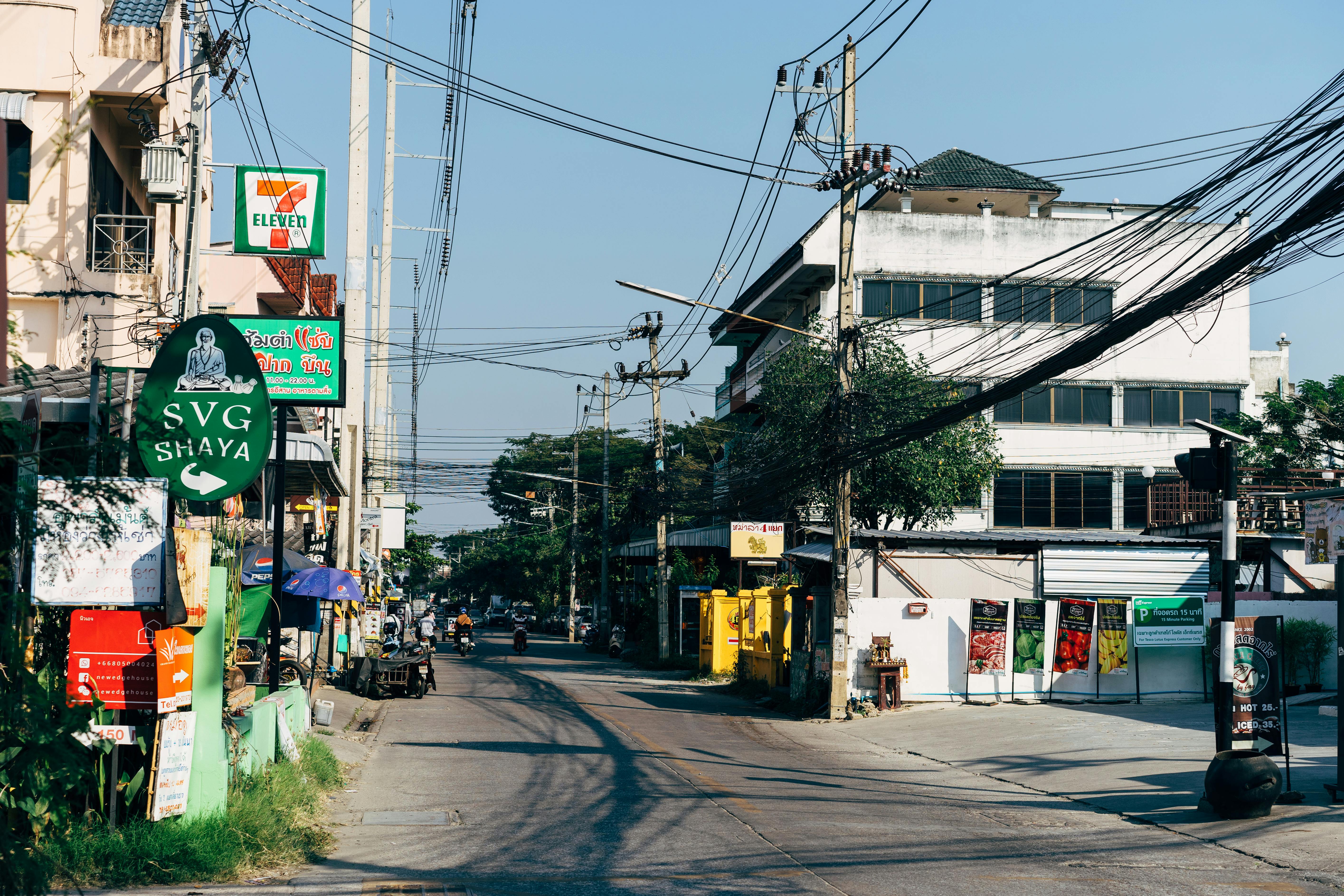
The nomad-vs-local split maps almost perfectly onto two neighborhoods. A decent one-bedroom in Nimman, the coworking and brunch district, runs about 12,000 THB ($384), against roughly 8,000 THB ($256) for the same in local Santitham (CNX Local, 2026). Furnished condos with a pool and gym in Nimman push $350 to $550.
| Neighborhood | Vibe | 1BR rent / month |
|---|---|---|
| Nimman | Nomad HQ, cafes, coworking | |
| City center (avg) | Convenient, mixed | |
| Santitham | Local, cheaper, near Nimman | |
| Outside center | Residential, need a scooter |
Rents are also no longer flat. Chiang Mai rents rose an estimated 4% to 6% year over year into early 2026, with Nimman appreciating fastest on nomad and expat demand (Bamboo Routes, 2026). A peer-reviewed study in the Information Systems Journal went further, documenting nomad-driven gentrification and local displacement in what it calls the “digital nomad capital” (Wiley ISJ, 2024).
Is the WiFi fast enough to actually work?
Yes, comfortably. This is where Thailand quietly outclasses richer countries. In December 2025, Thailand’s median fixed broadband download speed reached 275.26 Mbps, the 10th fastest in the world, on the Ookla Speedtest Global Index, ahead of Switzerland and most of Europe (WorldPopulationReview, via Ookla, 2025).
On the ground, fiber to the home from AIS, True, or 3BB runs 100 Mbps to 1 Gbps for about 590 to 1,200 THB a month (roughly $17 to $34) (Hawook, 2025). For your first few days, or as a backup when the condo router dies, grab a Thailand eSIM before you land so you have a hotspot from the airport.
Then there is the coworking scene. The “50 to 100 spaces” figure floating around is a myth; a 2025 field roundup counted just over 20 dedicated coworking spaces and cafes (Across Every Border, 2025). Day passes cluster tightly around 250 to 430 THB.
| Space | Area | Day pass | Monthly |
|---|---|---|---|
| Punspace | Tha Phae / Wiang Kaew | 289 THB (~$8) | 3,899 THB (~$111) |
| Alt_ChiangMai | Nimman edge | 320 THB (~$9) | 4,000 THB (~$114) |
| Yellow | Nimman | 429 THB (~$12) | 5,990 THB (~$171) |
| CAMP | Maya Mall (24h) | ~50 THB order = 2h WiFi | pay per visit |
According to coworking roundups, Punspace charges about 289 THB for a day pass and 3,899 THB (~$111) for monthly hot-desk access, while Yellow in Nimman runs 429 THB a day or 5,990 THB monthly with 24/7 entry (Goats On The Road, 2026). Budget $110 to $190 for a good membership.
The burning season is the reason to time your stay
Here is the honest downside nobody puts in the brochure. For roughly six weeks a year, Chiang Mai has some of the worst air on the planet. In 2026, the city topped IQAir’s global live ranking on 29 March with an AQI of 263 and PM2.5 near 188 micrograms per cubic meter (reported via IQAir data, 2026). Days later, some districts passed 300, nearly ten times Thailand’s safety standard, and three provinces were declared disaster zones (Bangkok Post, 2026).
This is not a one-off. Averaged over 2017 to 2023, Chiang Mai’s March and April PM2.5 was nearly 100 micrograms per cubic meter, about 20 times the WHO safe level, according to NASA’s Earth Observatory (NASA, 2024). For scale, Bangkok’s March spike only reached about 38.
The flip side: the rest of the year is clean. Once the monsoon arrives, PM2.5 drops to 5 to 10 micrograms per cubic meter by May, and Chiang Mai’s 2025 annual average was a “moderate” 18.2 (IQAir). The pattern is predictable enough to plan around.
| Period | Air quality | Nomad verdict |
|---|---|---|
| Nov to Jan | Clear, cool, low pollution | Best window, book early |
| Feb | Rising haze | Watch the AQI daily |
| Late Feb to April | Hazardous, world’s worst | Leave or stay indoors |
| May to Oct | Rainy but clean air | Underrated, cheaper |
Our take: Treat Chiang Mai as a nine-month city. The smart nomad play is to base here from November through February, then run to the islands, Vietnam, or Bali for March and April. Signing a 12-month lease means paying to breathe smoke for two of them.
Which visa lets you stay long enough?
This is the most fast-moving part of the whole equation, so treat any specific rule as “true when written” and re-check before you fly. As of early July 2026, citizens of 93 countries can still enter Thailand visa-free for 60 days, extendable once by 30 days at an immigration office for 1,900 THB (Tourism Authority of Thailand, 2026). That gets you up to 90 days without a real visa.
But there is a change in the pipeline. On 19 May 2026, the Thai Cabinet approved cutting that exemption to 30 days for most nationalities, a move that only becomes law 15 days after it appears in the Royal Gazette. It has not been published yet, so the 60-day window is still open. If you are planning a long stay, do not build it on a rule that is one government notice away from halving.
For anything beyond a few months, the real answer is the Destination Thailand Visa (DTV), launched in July 2024 and built for exactly this crowd. It is a 5-year multiple-entry visa giving 180 days per entry, extendable once inside Thailand by another 180 days for 1,900 THB (Acclime Thailand, 2026).
- Proof of funds: 500,000 THB (about $14,500) held for at least three months
- Government fee: 10,000 THB, roughly $280 to $400 depending on the embassy
- Apply from outside Thailand through the mandatory e-Visa portal
- The catch: no Thai work permit, and you cannot work for Thai companies or clients
The DTV drew more than 35,000 applications in its first year. If you earn from clients back home, it takes the visa-run treadmill off the table entirely. For the full rules, overstay penalties, and extension steps, see our Thailand visa guide.
Food, transport, and the small stuff
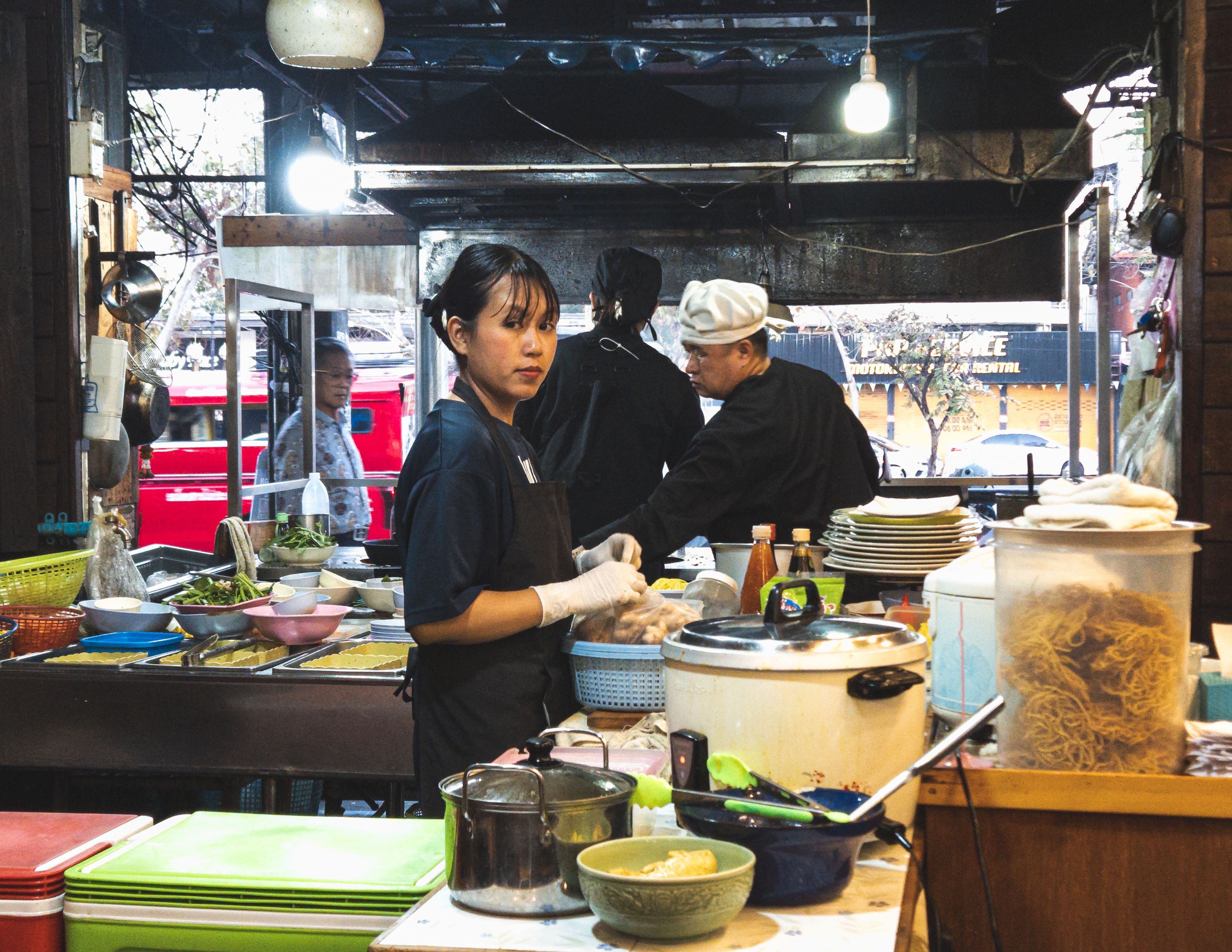
Daily life is where Chiang Mai still feels almost free. A meal at an inexpensive restaurant costs about 70 THB ($2), and a three-course dinner for two at a mid-range spot runs around 650 THB ($18) (Numbeo, July 2026). Eat local and $2 to $4 a meal is normal; a monthly grocery run lands at $150 to $300.
Getting around is just as cheap once you commit to two wheels. A monthly scooter rental is about 2,000 to 4,500 THB if you negotiate a long stay, and Grab rides run $2 to $5 a trip (CNX Local, 2026). Skip the scooter if you are nervous in traffic; Chiang Mai’s roads are the single biggest safety risk for nomads, far more than crime.
| Everyday cost | Typical price |
|---|---|
| Street food meal | 40 to 100 THB ($2 to $4) |
| Cafe coffee | ~70 THB ($2) |
| Dinner for two, mid-range | 650 THB ($18) |
| Scooter (monthly) | 2,000 to 4,500 THB |
| Grab ride | $2 to $5 |
None of this has spiked. Thailand’s cumulative inflation over the five years to end-2025 was only about 9.3%, and headline inflation was a mild 2.42% in June 2026 (Trading Economics, 2026). Rent is rising; noodles are not.
So, is Chiang Mai still worth it?
For most remote workers, yes, but the “obvious best choice” era is over. Chiang Mai has slipped from #1 on Nomad List in 2023 to #5 by mid-2026, and Expatistan now rates it about 24% cheaper than Bangkok but roughly 16% more expensive than Ho Chi Minh City (Expatistan, 2026). The cheapest-in-Asia title has moved to Vietnam.
What Chiang Mai still wins on is the whole package: fast fiber, a big established community, serious coffee, mountains fifteen minutes out of town, and a 5-year visa built for you. What it loses on is seasonal air and a Nimman scene that some long-termers call a self-contained expat bubble disconnected from Thai life (The Professional Hobo, 2024).
Come to Chiang Mai if you want a comfortable, easy base under $2,000 a month, value community over novelty, and can clear out for burning season.
Skip it if you need the absolute lowest cost (try Vietnam), want a beach, or plan to stay put through March and April. If a big-city buzz is more your speed, compare it against Bangkok first.
Ready to price out a stay? Start with flights and a monthly-rate condo.
Frequently Asked Questions
How much does it cost to live in Chiang Mai as a digital nomad?
Nomad List puts a typical nomad’s all-in monthly cost near $1,187 as of mid-2026. Realistically, a lean local lifestyle runs about $800 to $1,200, while a comfortable setup with a modern condo, coworking, and regular Western meals lands at $1,800 to $2,500.
Is Chiang Mai still the best city for digital nomads?
It is still elite but no longer unrivaled. Chiang Mai topped Nomad List in 2023 at #1 of 328 cities, sat at #5 globally by mid-2026, and ranked 3rd on Forbes’ 2026 list of cities nomads are moving to, behind Lisbon and Medellin. Vietnam is now the cheaper option.
When is the burning season and how bad is the air?
Burning season runs roughly February through April, worst in late February and March. On 29 March 2026, Chiang Mai topped IQAir’s global ranking with an AQI of 263. The air is cleanest and coolest from November to January, which is peak nomad season for good reason.
What visa do digital nomads use for Chiang Mai?
Most long-stayers use the Destination Thailand Visa (DTV): 5 years, multiple entry, 180 days per stay, with a 500,000 THB savings requirement. Short trips still get 60 days visa-free (plus a 30-day extension) as of July 2026, though a cut to 30 days is approved and awaiting publication.
Is Chiang Mai cheaper than Bangkok?
Yes. Expatistan rated Chiang Mai about 24% cheaper than Bangkok in early 2026, mostly on rent. However, it is roughly 16% more expensive than Ho Chi Minh City, so Chiang Mai is no longer automatically the cheapest digital nomad hub in Southeast Asia.
Plan your Chiang Mai stay
Chiang Mai rewards the nomad who plans around it: arrive for the clean, cool season, lock in a monthly condo rate, and sort the DTV before you fly.
- Search flights to Chiang Mai - compare 700+ airlines in one search
- See monthly condo and hotel rates - filter for long stays in Nimman or Santitham
- Get a Thailand eSIM - connected from the moment you land
- Read the full Chiang Mai guide - neighborhoods, temples, and food
- Check the Thailand visa rules - DTV, extensions, and overstay penalties
Use Paglipat to compare prices and plan your move to Thailand’s rose of the north.
Sources
- Nomads.com (Nomad List), Cost of Living in Chiang Mai - retrieved 2026-07-07
- Nomads.com (Nomad List), Chiang Mai for Digital Nomads - retrieved 2026-07-07
- Numbeo, Cost of Living in Chiang Mai - retrieved 2026-07-07
- CNX Local, Chiang Mai Cost of Living 2026 - retrieved 2026-07-07
- Expatistan, Bangkok vs Chiang Mai comparison - retrieved 2026-07-07
- Bamboo Routes, Updated Rents in Chiang Mai (January 2026) - retrieved 2026-07-07
- WorldPopulationReview, Internet Speeds by Country 2026 (Ookla data) - retrieved 2026-07-07
- Across Every Border, Coworking Spaces in Chiang Mai (2025) - retrieved 2026-07-07
- Goats On The Road, Best Coworking Spaces in Chiang Mai - retrieved 2026-07-07
- IQAir, Chiang Mai among top 10 most polluted cities (March 2026) - retrieved 2026-07-07
- NASA Earth Observatory, Hazy Skies in a Growing City - retrieved 2026-07-07
- Bangkok Post, Disaster declared in three northern Thai provinces - retrieved 2026-07-07
- Tourism Authority of Thailand, 60-day visa exemption revision - retrieved 2026-07-07
- Acclime Thailand, Destination Thailand Visa (DTV) - retrieved 2026-07-07
- MBO Partners, 2025 Digital Nomads Trends Report - retrieved 2026-07-07
- Information Systems Journal (Wiley), Digital nomadism and the “digital nomad capital” Chiang Mai - retrieved 2026-07-07
- Trading Economics, Thailand Inflation Rate - retrieved 2026-07-07
Some links on this page are affiliate links: if you buy or book through them we earn a commission at no extra cost to you. Read the full disclosure.
Read next

The Ultimate Travel Guide to Vietnam for 2026
Everything you need to plan your Vietnam trip in 2026. Visa requirements, top destinations, must-try food, budget tips, culture, health, and practical advice.
Feb 15, 2026
Pattaya Travel Guide 2026: Thailand's Beach Paradise
Complete Pattaya travel guide for 2026. Discover the best time to visit, top attractions, beaches, nightlife, food, and practical tips for Thailand's famous be…
Feb 8, 2026
The Solar Passage: Complete Guide to Thailand's Songkran Festival 2026
Everything you need to know about Songkran 2026 in Thailand. Discover the cultural traditions, regional celebrations, essential tips, and the spiritual meaning…
Feb 6, 2026